Ebook Free Silicon Snake Oil: Second Thoughts on the Information Highway
We know and also realize that sometimes publications will make you feel bored. Yeah, investing lot of times to just check out will specifically make it real. Nevertheless, there are some methods to conquer this issue. You can only invest your time to review in couple of web pages or only for filling the extra time. So, it will certainly not make you really feel bored to always encounter those words. And also one important point is that this book offers extremely interesting subject to read. So, when reviewing Silicon Snake Oil: Second Thoughts On The Information Highway, we make sure that you will certainly not locate bored time.
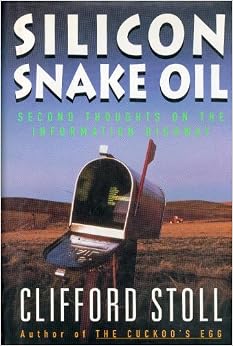
Silicon Snake Oil: Second Thoughts on the Information Highway

Ebook Free Silicon Snake Oil: Second Thoughts on the Information Highway
Being a much better person sometimes most likely is hard to do. Moreover, transforming the old habit with the new behavior is hard. Actually, you could not should change unexpectedly the old practice to chatting. Hanging around, or juts gossiping. You will require step by step activity. Moreover, the way you will certainly change your practice is by the analysis routine. It will make so difficult obstacle to deal with.
The book that is good for you has some qualities. Among them is that they have similar topics or motifs with things that you need. The book will certainly be likewise worried about the new ideas and also believed to be constantly current. Guide, will certainly also always provide you brand-new experience as well as truth. Even you are not the professional of the topic associated, you can be better underrating from checking out the book. Yeah, this is just what the Silicon Snake Oil: Second Thoughts On The Information Highway will certainly provide to you.
When obtaining guide Silicon Snake Oil: Second Thoughts On The Information Highway by on-line, you could review them any place you are. Yeah, also you are in the train, bus, waiting checklist, or various other places, online e-book Silicon Snake Oil: Second Thoughts On The Information Highway could be your buddy. Every time is a great time to review. It will certainly improve your knowledge, enjoyable, enjoyable, driving lesson, and experience without investing more cash. This is why on-line e-book Silicon Snake Oil: Second Thoughts On The Information Highway comes to be most really wanted.
Caring this book suggests loving your leisure activity. Reading this book will certainly mean top life high quality to be much better. Better in al point might not be attained in short time. But, this publication will certainly help you to always boost the compassion and spirit of far better life. When finding the Silicon Snake Oil: Second Thoughts On The Information Highway to download and install, you may not ignore this. You have to get it currently as well as review it quicker. Sooner you read this book, quicker you will certainly be more success from previous! This is your choice as well as we constantly consider it!
From Library Journal
Stoll, a Berkeley astronomer who chronicled how he broke a computer spy ring in The Cuckoo's Egg (LJ 9/15/89) and who has been netsurfing for 15 years, does an apparent about-face here, warning that the technophiles are trying to sell us a bill of goods on the promise of the Internet?one on which it can't deliver and that, ultimately, both ignores the cost of forsaking human interaction and actual financial costs. His is a lone voice countering the mass of media hype that has been touting the national information superhighway and the rush of individuals and businesses to get connected. In chapters dealing with everything from education to E-mail (Stoll reports he lost less mail via the U.S. Postal Service) to the "virtual" library, he details the limitations of the networks. Though he is occasionally not quite up to the minute on some library implementations, his message nevertheless should be read as a caution to every librarian rushing down the information highway. [For an interview with Stoll and an excerpt from his book, see p. 100.]?Francine Fialkoff, "Library Journal.-?Francine Fialkoff, "Library Journal"Copyright 1995 Reed Business Information, Inc.
Read more
From Booklist
When a computer expert has second thoughts about the information highway, we should slow down and listen. Stoll is skeptical of the overblown promises of technology mavens, government officials, industry hacks, and educators that, he says, first produce bloated expectations and then burst bubbles. "Lotus-eaters, beware," he writes, virtual reality is no substitute for the real thing: computers alter our thinking processes; they isolate us and minimize social interactions; they are expensive and difficult to use; and they become obsolete in a few years. The Internet is a disorganized waste land, and E-mail isn't as good as the U.S. Postal Service. In chapter 11, Stoll expresses fear for the future of libraries: too much of libraries' resources are being devoted to technology, he says, and not enough to books and librarians. Ultimately, though, Stoll contradicts himself too often: in one sentence, he fears the demise of libraries; in the next, he states why book-based libraries won't disappear. What's more, he undermines his argument's seriousness with comic footnotes and deliberately improper grammar. Still, his book signals the first wave in the backlash against the race to the future that computer technology now represents. Benjamin Segedin
Read more
See all Editorial Reviews
Product details
Hardcover: 247 pages
Publisher: Doubleday; 1st edition (March 1, 1995)
Language: English
ISBN-10: 0385419937
ISBN-13: 978-0385419932
Product Dimensions:
6.5 x 1 x 9.5 inches
Shipping Weight: 1.1 pounds (View shipping rates and policies)
Average Customer Review:
3.4 out of 5 stars
47 customer reviews
Amazon Best Sellers Rank:
#2,393,452 in Books (See Top 100 in Books)
I'm not too heavy of a reader, I'll admit.I found out about Clifford Stoll by reading his piece in Newsweek about the future of the internet. It's great to hear differing opinions, even if they may be horribly wrong. I applaud his ability to go against the hivemind and speak his own mind. The book is no Stephen King novel, but I personally thoroughly enjoyed reading it.
first book was better
I feel a little bit guilty in writing a review for a book about computing that is now several years old. As other reviewers have noted, there's a lot about this book that is horrendously dated: e-commerce is well-established, network access speeds have long since shattered 9600 baud, Usenet is (for all intents and purposes) dead.But move beyond that for a minute. Ignore anything he says about download speeds (although you should consider that, according to the Pew Internet Project, only 42% of Americans have high-speed Internet access at home, so broadband isn't as ubiquituous as some would like us to believe). Smile when he questions the concept of e-commerce. Every time he references Usenet or newsgroups, mentally substitute blogs and web forums; do the same substition with MUDs and World of Warcraft.Even now, 12 years after the fact, the questions that he raises are still important and relevant. While I can find fantastic recipes for bread online, it doesn't actually tell me anything about that instant when you know you've kneaded the bread long enough. Getting driving directions online is great, until you realise that construction or an accident is blocking your intended route and you can't figure out how to get around it because you don't have an actual paper map. Kids learning how to use computers is great, but when they can't do basic arithmetic or write a five-paragraph essay, how can we justify spending millions every year on computers in the classroom?For all that I think that the questions that he raised need meaningful answers, I found the book unsatisfying. Stoll is obviously a computer geek himself, and was a heavy computer and Internet user at the time that he wrote the book, so it is frustrating that he offers up so much criticism without tempering it with some statements about what he does find useful online. The book reads like a conversation, which is somewhat annoying because it wanders all over the place and gets a bit repetitive. It could have been tightened up into a highly-compelling work.
I had to read this for my English class, and I must say this might be the must frustrating book I've ever read. It is so wrong, and outdated on most accounts that getting through it is near painful. On another note, I hate Stoll's writing style and he obviously doesn't know how to argue a point (constantly contradicting himself.) Don't bother with this trash unless you have to.
An impressive, multi-facetted, meandering chaotic, sometimes repetitive exploration of the barrenness of web technolculture. Such books should be read for balance (with 'Small is Beautiful' by Schumacher on appropriate technology) against the ultra-hyped Web-is-all techno-imperialism seemingly practised by global media and vested interests. Despite now being dated, it still happens to be a good-read (bonus!).An overview of 'Silicon Snake Oil' contents follows.Some drawbacks of vehicular highways in America, unforeseen include: the mass destruction and paving of the countryside; hour-long commuting faced by many workers; and pollution. Does the Internet similarly dehumanize through it's virtual world? Is it's use passive rather than active? How high (i.e. desirable) is the signal-to-noise-ratio? Is the amount of true productive output (from business processes) very low compared with the time spent (input) by the majority of users? The lemming-like hyped adoption of technologies impacts little on human, real and productive (mental, physical or other) pursuits such as cooking, driving, dancing, building and praying. The Internet in practice frustrates many with slow speeds during the working day; has poor navigation for finding quality information (even with the best efforts of search-engines and web-guides); is physically limited in the number of domain names available; has many fly-by-night companies trying to initiate electronic price-centred commerce; and is similar to television with many channels and much mediocrity. Interactive multimedia- the goal of many sites and intranet implementations- is essentially human-interaction-based (i.e. like real life). Limitations in human-computer-interaction limit creativity in games or business to linear progression through puzzlers/processes and increased hand-eye co-ordination (a crayon and pad is much more free-style). Where is the value for money- when a cheap pack of playing cards can be used in an infinite number of games, yet a computer programme costs 10 to 20 times as much and needs expensive computers/consoles to run on? Also, Internet-inspired mental-entrapment with physical interaction undermines social relationships (often gender-specific)- leading to a noted increase in computer-widows. Some pundits have claimed e-mail has inspired a literary revival- yet many messages and web-pages are mediocre at best. The speed of e-mail and on-line charges lead to informality and errors in e-mail (even through spell-checkers are common). The anonymity, untraceability and credibility through access, remove social constraints and can lead to cultural and personal insults. The metaphor of interaction in the web misses a permanence, warmth, and local history- it is not a reality. The computer and Internet are tools which should not replace critical thinking nor constrain solutions. We program computers and they program us- how many times have you wanted to "undo" a physical or verbal action in real-life? It is suggested that the truly creative are often not able to use computers.Network/connection skills, due to the openness of connectivity all vary and change frequently- it's not a permanent skill- the need to keep up to date can be threatening and suffocating. Telecommuting, with the lack of physical meetings and personal interaction, often isolates workers and reduces loyalty. There is a concern for privacy in a connected and open electronic business world. Posting a few web pages, and joining as few mailing lists results in a few dozen messages per day- which need to be glanced at in case something important is enclosed- naturally an information and mailbox overload. A good proportion of "quality" information on the Web are lesser research results not worthy of publication in "real" academic journals. Computer technology elitism (the super connected North Americans versus relatively unconnected Africans) ignores the poor. Access to a universe of information can't solve all problems. The users are not paying for the infrastructure, which is subsidized.The complexity of computers lead to frustration compared with similar technology yet simpler to use televisions and VCRs. There is a culture of exclusion, and jargon accessed through a keyboard designed to slow typists. All commercial software has bugs and crashes machines. Repetitive Strain Injury, TSV etc. are increasingly common. Perhaps computer users should work whilst using a treadmill (from fitness); say hello to 5 people prior to switching the computer on (for social skills); and read a novel after every computer manual (for sanity!). There is a 1000 page manual for using Microsoft Word- a simple program- which is more difficult to learn and more unreliable than driving a car. There is increasingly-fast obsolescence of technology- not sustainable in business even compared to cars; which includes a steep learning curve to be overcome with each new (often un-needed) version of software. Yet simplicity, reliability, and ease-of-training are more important than features. There is a barrenness of technoculture- what artifacts will be left for future historians? Even e-mail between different systems is unstandardized and often unreliable. Computerization can add a false staff credibility.
Silicon Snake Oil: Second Thoughts on the Information Highway PDF
Silicon Snake Oil: Second Thoughts on the Information Highway EPub
Silicon Snake Oil: Second Thoughts on the Information Highway Doc
Silicon Snake Oil: Second Thoughts on the Information Highway iBooks
Silicon Snake Oil: Second Thoughts on the Information Highway rtf
Silicon Snake Oil: Second Thoughts on the Information Highway Mobipocket
Silicon Snake Oil: Second Thoughts on the Information Highway Kindle
0 komentar:
Posting Komentar